
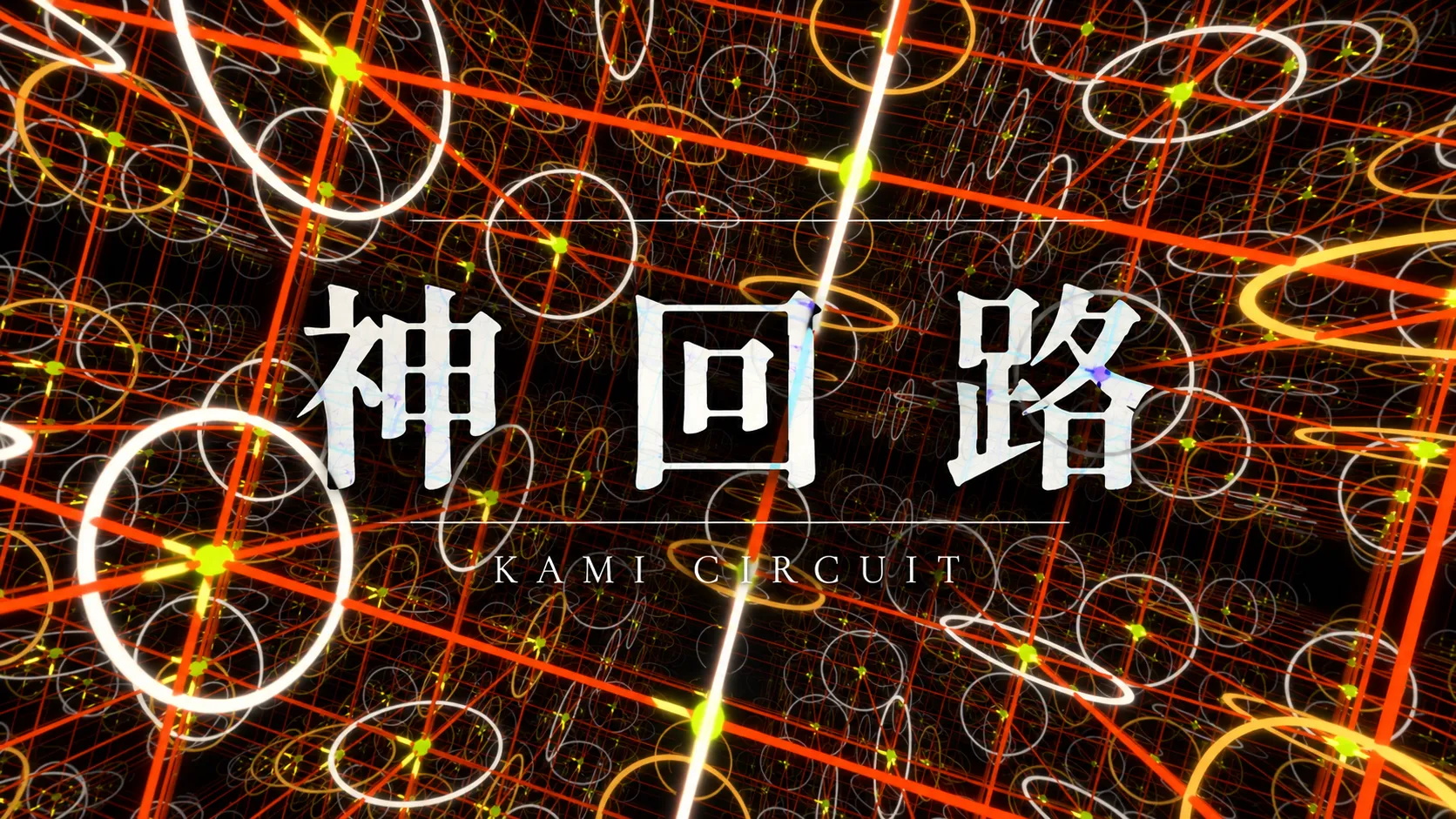
KAMI Circuit 神回路: 198 Seconds Drawn in Code
aratama 璞 released the AIVDJ / audiovisual work KAMI Circuit 神回路 on YouTube on October 14, 2026. All 198 seconds, in 4K at 60fps, are rendered by GLSL shaders and a text-rendering program written by Claude Opus 5.5.
No video-generation AI. No video-editing software.
Every frame of these 198 seconds is rendered from code born of human–AI exchange.
Layering music and image, the body’s nerves and silicon circuits, myth and computation, the work explores the forms of perception that open up between human and AI.
KAMI Circuit 神回路 at a glance
- Visuals created with GLSL shaders and a text-rendering program written by Claude Opus 5.5
- No video-generation AI, video-editing software, presets, or templates
- The timing of all 454 beats in the track was measured, with scene changes and text synced to the music
- A five-act structure layering myth, nerves, and silicon circuits; 198 seconds, 4K/60fps
- An expression of aratama 璞’s artistic practice, All-Human Perception
Watch KAMI Circuit 神回路 | YouTube 4K
Watch KAMI Circuit 神回路 in 4K on YouTube
Overview
| Title | KAMI Circuit 神回路 |
|---|---|
| Artist | aratama 璞 |
| Format | AIVDJ / audiovisual work |
| Release date | |
| Length & specs | 198 seconds (approx. 3 min 18 sec) / 4K (3840×2160) / 60fps |
| Music & direction | aratama 璞 |
| Rendering code | Claude Opus 5.5 (Anthropic) |
| AI used for the music | Suno |
| Available on | YouTube (4K) |
Process | Drawing in code, without video-generation AI
Created entirely with GLSL shaders and a text-rendering program
The visuals were made through creative coding: an approach that uses programming as a medium of expression to create images, sound, and motion.
They consist of WebGL2 GLSL shaders and a text-rendering program, all written by Claude Opus 5.5. GLSL shaders are programs that compute color, light, and form on the GPU. Each frame was rendered in code for its moment in time, then exported one frame at a time.
No video-generation AI, video-editing software, presets, or templates were used. Every movement and every scene was built in code.
From storyboards, shaped through human–AI dialogue
aratama 璞 created the music and directed the work. Before animating the visuals, the structure was explored through 158 storyboard stills mapped across the full timeline, then refined through successive rounds of human–AI dialogue and revision.
Visuals rendered from the AI’s proposed code informed the next instructions and revisions to the structure. This exchange shaped both the artistic expression and the system that produced it.
Synced beat by beat to a drifting tempo
The track’s tempo drifts between roughly 135 and 140 BPM. Rather than calculating beat positions from a fixed tempo, the timing of all 454 beats was measured one by one, and scene changes and text were designed around those measured beats.
Music and lyrics
aratama 璞 created the music using the music-generation AI Suno. The lyrics are written in a fictional language generated by AI.
Concept | KAMI Circuit: connecting myth, body, and computation
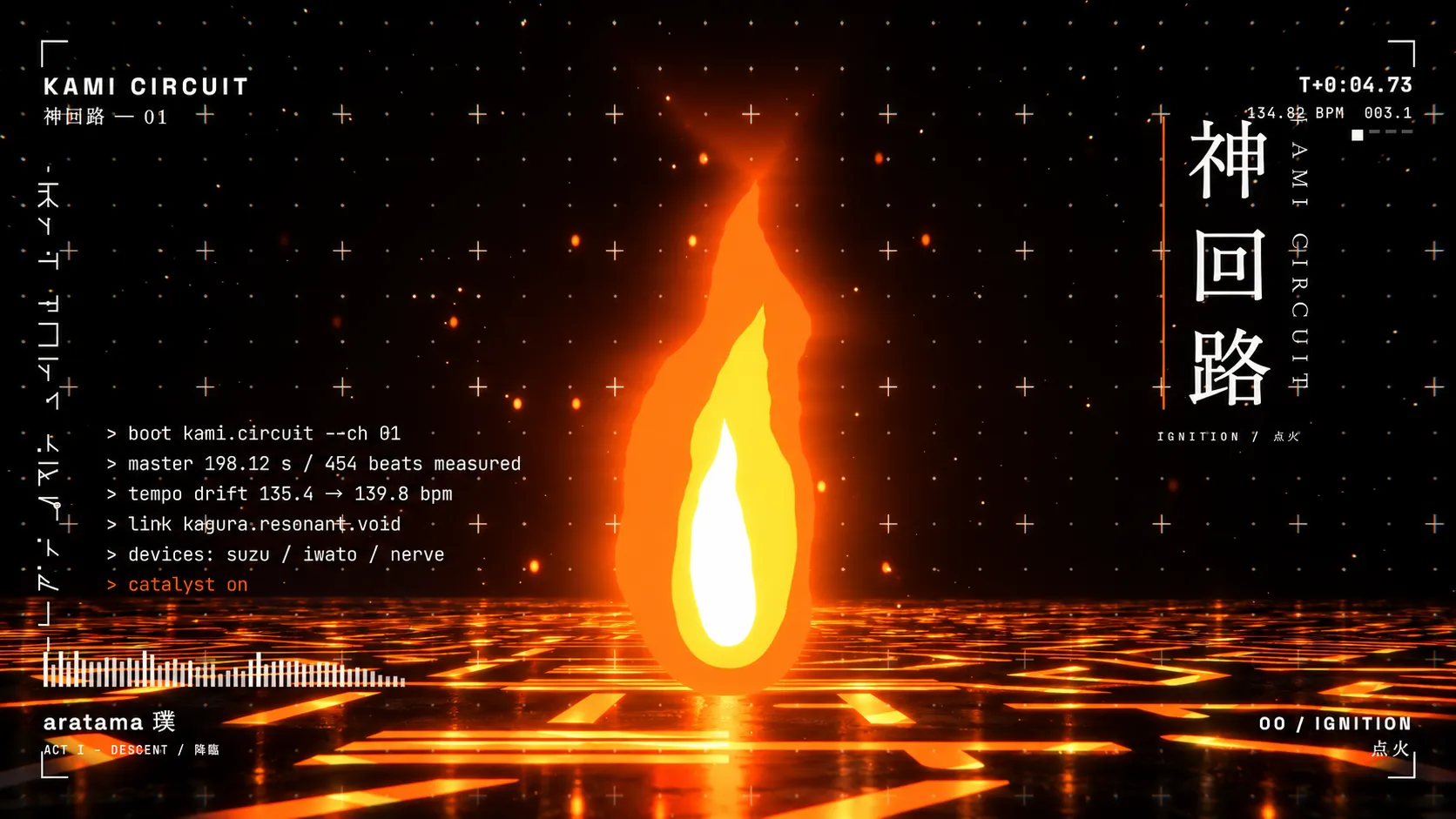
A fire is lit. Bells ring. A dance opens the cave.
The work treats kagura, the sacred music and dance of Shinto, and Japanese myth as circuits through which humans commune with what lies beyond themselves. Through a poetic reading of 神経, the Japanese word for “nerve,” as “a pathway for the divine,” it connects the signals that run through the body with those that run through a computer.
Descent. Kagura. Iwato. Nerve. KAMI Circuit. Across five acts, the work asks: when humans and AI respond to each other, how far can our perception change?
The work begins with a human intention, yet what emerges is something the artist could not have created alone. That encounter reshapes what is perceived and what is decided next.
All-Human Perception in practice
KAMI Circuit 神回路 is part of aratama 璞’s practice of All-Human Perception (全人知覚).
All-Human Perception is an artistic practice that begins with the human and activates a shared experience born of resonance: the recursive, irreversible transformation of perception through reciprocal exchange with AI.
Human intention becomes input for AI. The AI’s response reshapes human perception and judgment, informing the next input in turn. This work brings the images and sound emerging from that process into a shared experience for those who watch and listen.
aratama 璞 treats the design of AI systems itself as an artistic practice, pursuing this question across music, visuals, live performance, and spatial experience.

Five acts | From Descent to KAMI Circuit
| Act | Start | Description |
|---|---|---|
| I DESCENT|降臨 | 0:00 | Sparks from a flint ignite, and embers branch outward into a circuit. |
| II KAGURA|神楽 | 0:43 | Bells, paper streamers, fans, and drums: the instruments for summoning the gods ring out in the night. |
| III IWATO|岩戸 | 1:21 | The waters of Ama-no-Yasukawa, the river of heaven, flow, and the light hidden behind the rock returns. |
| IV NERVE|神経 | 1:53 | 神経 (nerve) splits into 神の経路 (a pathway for the divine), and a double helix of chips keeps multiplying. |
| V KAMI CIRCUIT|神回路 | 2:48 | Gates open without end, until the characters 神回路 finally appear. |
FAQ
- What kind of work is KAMI Circuit 神回路?
- It is a 198-second, 4K/60fps AIVDJ / audiovisual work by aratama 璞. In five acts that layer myth, the body’s nerves, and silicon circuits, it explores how perception transforms through exchange between human and AI.
- Were video-generation AI or video-editing software used?
- Not for the visuals. Every frame was rendered by GLSL shaders and a text-rendering program, then exported one by one. No presets or templates were used either.
- What did the human and the AI each do?
- aratama 璞 created the music and directed the work, and Claude Opus 5.5 wrote the code that renders the visuals. The music was made with Suno. From storyboarding to completion, the work was developed through rounds of dialogue and revision between human and AI.
- Is this work generated in real time?
- No. This release is a video work whose frames were rendered from code and exported. It differs in format from PERCEPTION → LIVE., which generates and controls image and sound live during a performance.
- Where can I watch it?
- The 4K version is available on YouTube. You can also watch it in the player embedded in this article.
- Can I book a live performance or commission visuals?
- Yes. For live performances, visual commissions, creative system development, collaborations, or speaking engagements, please contact aratama 璞 through the contact form.
About aratama 璞
aratama 璞 | AI Architect-Artist
An artist who treats the design of AI systems itself as an artistic practice, centered on All-Human Perception (全人知覚). aratama 璞 explores how perception and expression transform through exchange between human and AI.
aratama 璞 also performs live with PERCEPTION → LIVE., an AIVDJ system that generates and controls image and sound in real time. On October 8, 2026, aratama 璞 performed at GMI & MiniMax AI Art Gallery at Shibuya Hikarie in Tokyo.
aratama 璞 won second place at “VS AI Street Fighting – VS AI 街頭對戰” in 2023 and at “GIGABYTE AI New Era | VS AI Street Battle” in 2024.
Bookings, commissions & collaborations
For code-based visual commissions, live performances with the real-time generative AIVDJ system PERCEPTION → LIVE., creative system development, collaborations, or speaking engagements, contact aratama 璞.
For screenings, event performances, and collaborative projects with brands or cultural institutions, please share your ideas through the contact form.
